lab
context
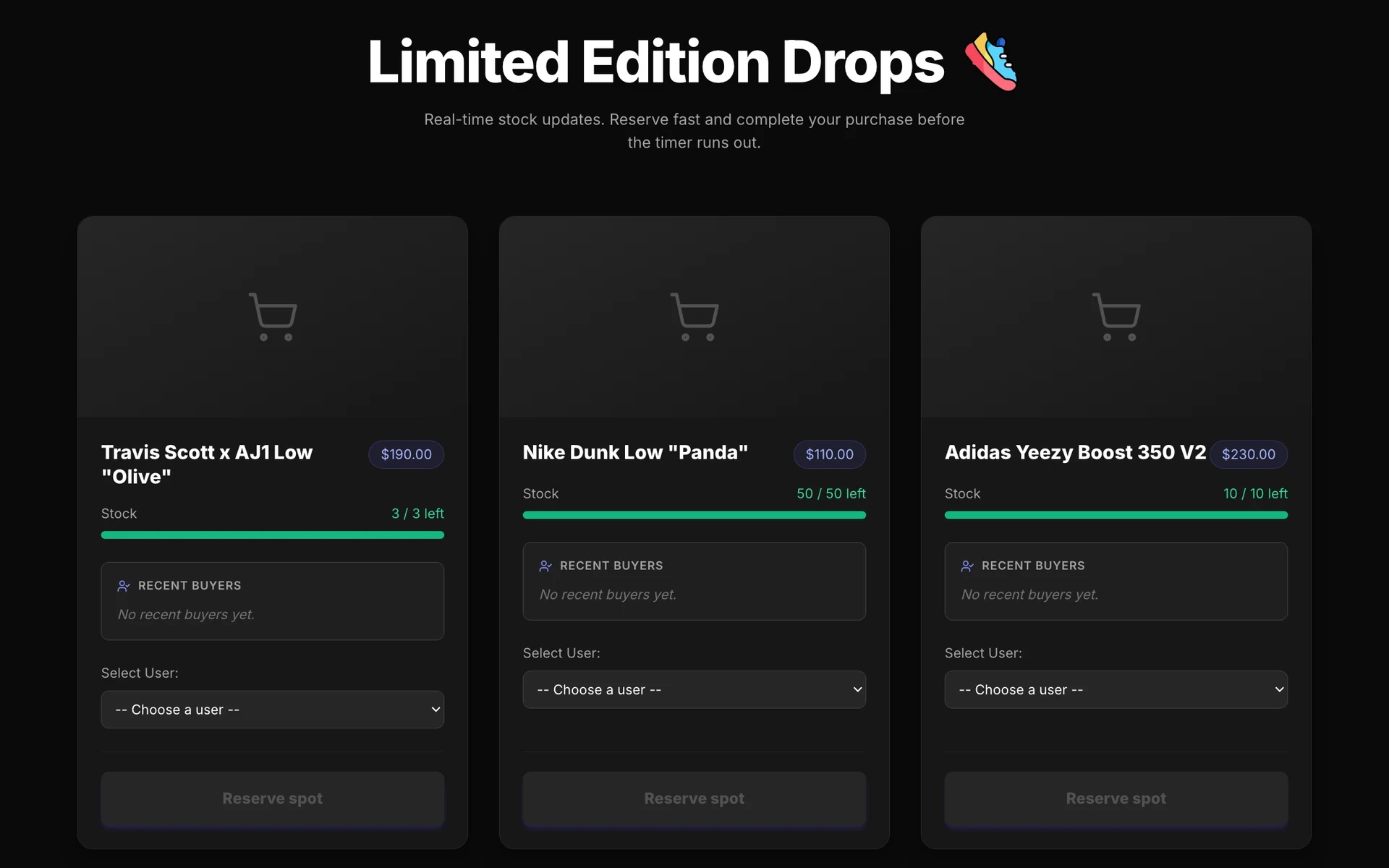
A focused experiment on one question: when many buyers hit the last unit of a limited drop, can more than one of them win? A user reserves one unit, which holds it for 60 seconds, then buys it before the hold expires. My first version answered the question with a row lock and an in-process timer. I rewrote it so the guarantees come from the database rather than from application timing, and so I could measure the difference.
decisions
- 01A conditional
UPDATEinstead ofSELECT … FOR UPDATE. Reserving runsUPDATE … SET availableStock = availableStock - 1 WHERE … AND availableStock > 0(simplified: it also adds back a unit from the caller's own overdue hold). Both approaches serialize buyers on the drop row, so the difference is cost and fragility, not safety. The conditional update is one statement, with no read-modify-write in the application to get wrong, and aCHECKconstraint on stock is the backstop if some other code path ever tries to oversell.FOR UPDATEstays the right tool when the decision needs several reads that can't be one predicate. - 02Purchase and expiry share one conditional transition. Both leave
pendingthrough anUPDATE … WHERE status = 'pending', so whichever commits first wins and the other matches no row. The old timer read a reservation without a lock and later wroteexpiredunconditionally, so a purchase committing in between was overwritten and the sold unit went back on sale. Purchase also checksexpiresAtitself, so it never depends on the sweeper having run. - 03A database sweeper instead of a timer per reservation. Timers were lost on every restart, leaving holds pending forever. The sweeper runs once at startup, which recovers anything that expired during downtime, then every 5 seconds. It takes a transaction-scoped advisory lock so only one sweep runs at a time, and
FOR UPDATE SKIP LOCKEDso it skips a reservation that a purchase is changing instead of waiting behind it. PlainFOR UPDATEwould still be correct, but the sweeper would stall behind every in-flight purchase. The cost is lag: a unit can return to stock up to one sweep interval after its deadline. - 04
reservereleases the caller's own overdue hold first. Waiting for the sweeper meant re-reserving right after a deadline returnedALREADY_RESERVED(orSOLD_OUTif that hold was the last unit). It also deadlocked with the sweeper, because the two took the reservation and drop locks in opposite orders. Nowreserveexpires its own overdue hold before touching the drop, which is the sweeper's lock order.
evidence
- 0119 integration tests against a real Postgres, run in CI on pushes to
developand on pull requests. After each scenario they assert thatavailableStock + pending + completed = totalStockand that purchases equal completed reservations. - 0240 concurrent reservers for 10 units: exactly 10 succeed, 30 get
SOLD_OUT, stock is 0. One user making 10 concurrent attempts gets one reservation and nineALREADY_RESERVED. Ten concurrent purchases of one reservation create one purchase, with the same id returned to every caller. - 03Forced purchase-versus-expiry races: one side's transaction is held open, the test waits until
pg_stat_activityshows the other side queued on the lock, then commits. If expiry commits first, the purchase is refused withRESERVATION_EXPIREDand the unit returns once. If the purchase is in flight, the sweep returns without waiting and the sold unit is not restored. A stress test runs 60 users and 30 units over five rounds, with purchases (some duplicated) racing five parallel sweeps, and the invariant holds after every round. - 04
npm run test:mutationinjects eight deliberate bugs one at a time (for example: sweeper ignoresstatus, purchase skips the deadline check, reserve has no stock condition), runs the suite, and exits non-zero if any survives. The writeup records no survivors, in about 13 seconds. Two of the eight are liveness bugs (noSKIP LOCKED, no advisory lock) that leave the data correct; the tests catch the first by checking that the sweep did not wait. The second's real risk, sweepers deadlocking across several drops, is not reproduced by the single-drop test. - 05Benchmark with
npm run bench:reserve: one drop, 3000 reservations per run after 200 warm-up, each by a distinct user, pool of 64, three runs, on an Apple M4 with Node 24 and Postgres 16 in Docker on the same machine. At 1, 8, 32 and 64 concurrent workers, the conditionalUPDATEdid 1190–1346, 1480–1560, 1199–1224 and 949–1027 ops/s;SELECT … FOR UPDATEdid 1056–1154, 1108–1186, 906–1018 and 676–848. At 8 workers p99 was 18–20 ms against 95–116 ms. The stock invariant held in every run. Both are correct; the difference is cost. Neither scales with concurrency, because every attempt queues on the same row lock, and run-to-run variance is about 15%. - 06Full reasoning, SQL and the mutation table:
docs/reservations.md. writeup
limits
- 01Users are selected, not authenticated.
userIdcomes from the request body, so any client can act as any user. It's a demo shortcut. - 02One hot row per drop: throughput is bounded at roughly 1000–1500 reservations a second on my laptop. Splitting the counter into buckets or putting a queue in front would raise it; I haven't built either.
- 03Stock returns up to 5 seconds after a hold's deadline, except to the holder re-reserving the same drop.
- 04The tests run in one Node process against one Postgres. The sweeper is built to be safe with several app instances, but I haven't run two.
- 05The benchmark was run before the overdue-hold step was added to
reserve, and I haven't rerun it. - 06The original 100-user HTTP race script still exists (
npm run test:atomic) but needs a live backend and isn't in CI; the integration suite is what CI runs.
stack
- Node.js
- Express
- PostgreSQL
- Sequelize
- Socket.io
- React
- TypeScript